Diabetes Drugs for Weight Loss: 9 Medications That Work


Key takeaways
- Some diabetes drugs can cause significant weight loss. Others have little to no effect on your weight, and some can even cause weight gain.
- The diabetes drug Mounjaro (tirzepatide) tends to lead to the most weight loss, followed by Ozempic (semaglutide). Rybelsus (oral semaglutide) and Victoza (liraglutide) typically give more modest weight loss.
- The same active ingredients are also available in medications approved exclusively for weight loss, such as Wegovy, Zepbound, and Saxenda.
Understanding how different diabetes medications affect your body is the first step toward managing both your blood sugar and your weight.
We investigate how these treatments work, their potential side effects, and how to find the right path for you.
How do diabetes drugs help with weight loss?
Diabetes medications help patients with type 2 diabetes in managing their blood sugar levels. Some of these drugs have also been shown to cause weight loss in people with overweight or obesity.
The medications that support weight loss generally fall into two distinct groups, and they work in completely different ways.
GLP-1 receptor agonists:
- Lower blood sugar by encouraging your pancreas to release insulin
- Reduce your overall appetite
- Slow down stomach emptying, making you feel fuller for longer
SGLT-2 inhibitors:
- Filter out extra blood sugar in the kidneys
- Release it through your urine
Diabetes drugs are not prescribed alone. Your provider will also prescribe healthy lifestyle changes to be used with the medication. These habits help keep blood sugar levels stable and make the medication more effective. They can also help with weight loss.
Healthy lifestyle changes used with diabetes drugs include:
- A healthy diet: Your provider will recommend a diet rich in vegetables, fruits, whole grains, and lean proteins (like chicken and fish). They may also recommend cutting your calorie intake and avoiding high-fat, sugary, and overly processed foods.
- More exercise: Your provider will recommend an appropriate exercise program for you and your fitness level.
How much weight can I lose with diabetes drugs?
Patients on Mounjaro (tirzepatide) lost the most weight and faster, reducing body weight by 15% after one year. Ozempic (semaglutide) patients lost 8% after one year. Victoza (liraglutide) patients lost around 2% to 6% of their body weight after a year. Other diabetes drugs such as Trulicity (dulaglutide), Glucophage (metformin), and Rybelsus (semaglutide) cause weight loss between around 1% to 5%.
What diabetes drugs help with weight loss?
To give you an accurate baseline, clinical data typically evaluates these medications over a standard one-year timeline (52 weeks). When used alongside healthy lifestyle changes, diabetes drugs generally fall into a clear ranking:
- Mounjaro (tirzepatide): Diabetes patients on the highest dose (15 mg) tend to lose the most body weight, averaging about 14%.
- Ozempic (semaglutide): Patients on standard diabetes doses of Ozempic lose an average of 5% to 6%.
- Victoza (liraglutide): Patients taking 1.8 mg daily lose an average of around 5%.
- Other diabetes drugs: Trulicity (dulaglutide) and Rybelsus (oral semaglutide) typically lead to a weight loss of around 5% or less, while SGLT2 inhibitors and metformin tend to cause a more modest weight loss of 2% to 3%, that is typically achieved early on and maintained through the year.
Injectable diabetes drugs
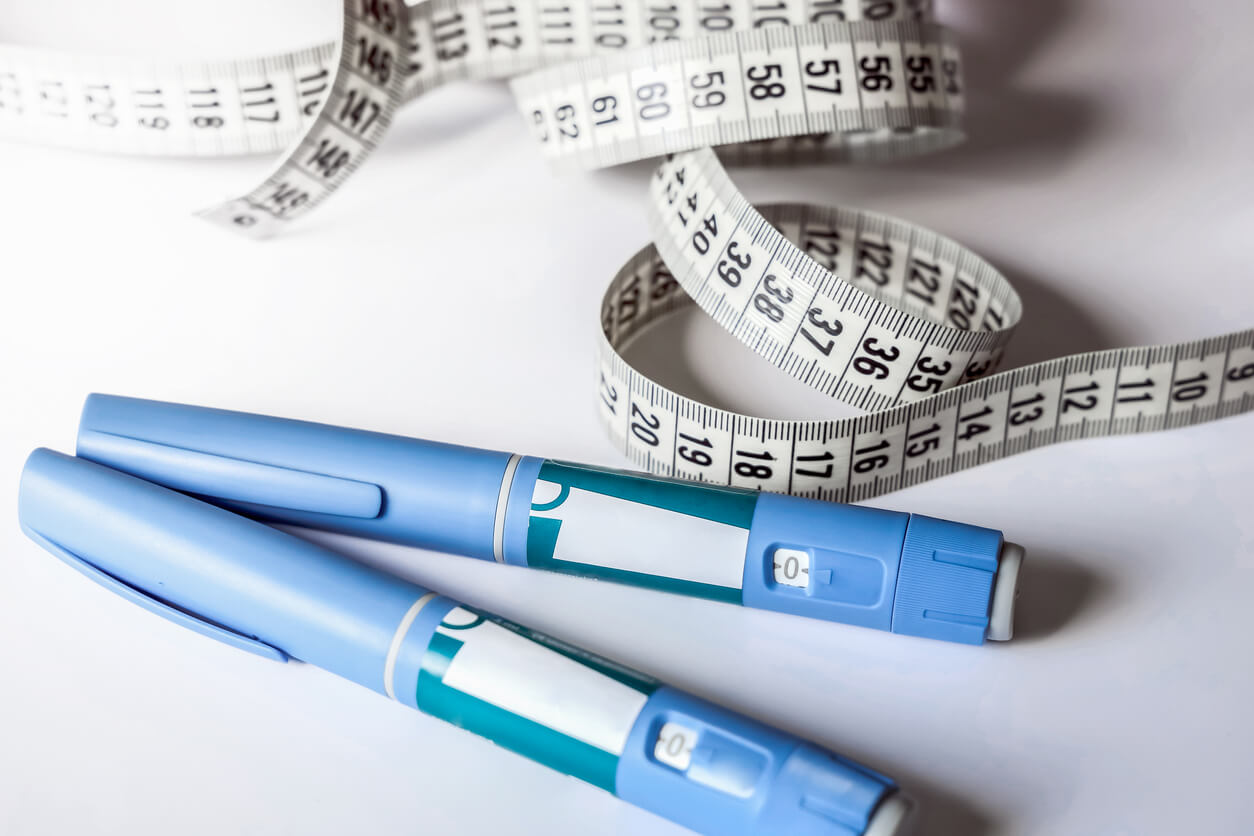
Weekly or daily injections are currently among the most powerful options available for both blood sugar control and significant weight loss.
Mounjaro (tirzepatide)
Mounjaro is a once-weekly injection that stands out because its active ingredient tirzepatide targets two metabolic hunger hormones (GIP and GLP-1) instead of just one.
Mounjaro is available as 2.5 mg, 5 mg, 7.5 mg, 10 mg, 12.5 mg, and 15 mg injection pens. Clinical trials showed that the higher doses of Mounjaro helped patients lose an average of 14% of their body weight in 52 weeks.
Mounjaro is sold from $1,080/ 28-day supply without insurance.
Ozempic (semaglutide)
This once-weekly GLP-1 injection is arguably the most famous medication in this category. It manages blood sugar but also helps lower the risk of heart attacks and stroke.
Ozempic is available as 0.25 mg, 0.5 mg, 1 mg, and 2 mg weekly injection pens. Clinical data shows that patients taking standard diabetes doses lose an average of 5% to 6% of their body weight over 52 weeks.
The retail price for Ozempic typically ranges between $900 and $1,000 per month without insurance.
Trulicity (dulaglutide)
This once-weekly injection is designed to hide the entire needle inside the single-use pen. That's why it's a common choice for people who are nervous about needles.
Doses range from 0.75 mg up to 4.5 mg and the weight-loss effect tends to be more modest, with patients averaging under 5% body weight loss over the course of a year.
Retail pricing starts at around $1,007 per month without insurance.
Victoza (liraglutide)
Belonging to an older generation of GLP-1 medications, Victoza is injected daily. Among the standard doses are 0.6 mg, 1.2 mg, and 1.8 mg.
In clinical trials, patients lost an average of 4.5% of their body weight over 52 weeks on the 1.8 mg dose. Out-of-pocket costs typically start around $544 per month without insurance.
Oral diabetes drugs (pills)
If you prefer to avoid needles, oral tablets are a good alternative.
Rybelsus (semaglutide)
Rybelsus is the first and only GLP-1 pill approved to treat type 2 diabetes in adults. Like Ozempic, its active ingredient is semaglutide.
Rybelsus is available as 3 mg, 7 mg, 14 mg oral tablets, taken once daily. Patients with type 2 diabetes lose an average of 5% of their body weight over 6 to 12 months when taking this medication.
Rybelsus starts at $997.58 per month without insurance.
Jardiance, Farxiga, Invokana
These oral tablets belong to the group of SGLT2 inhibitors. Instead of quieting your appetite, they work directly with your kidneys to filter excess sugar out of your blood. This blood sugar is then released through your urine.
Patients lose an average of 2% to 3% of body weight within the first 3 to 6 months, and tend to keep that weight off through 52 weeks of treatment.
Without insurance, pricing for a 30-day supply varies by brand, with Jardiance starting near $350, Farxiga around $405, and Invokana at roughly $724. However, some of their generic versions can cost as little as $15 for a 90-day supply.
Other options in the group of SGLT2 inhibitors include Steglatro and Brenzavvy.
Metformin
Metformin lowers how much blood glucose your body makes and absorbs, while also making you more sensitive to insulin.
It can be prescribed in its generic form as immediate-release (IR) taken 2–3 times daily with food, or extended-release (XR) tablets taken once daily.
Metformin causes less weight loss compared to GLP-1 agonists and SLGT2 inhibitors. Studies typically show patients taking metformin lost 2% to 3% of their body weight over longer periods of time.
Generic metformin can range from $4 to $20 for a 30-day supply.
Do diabetes drugs cause side effects?
Before starting treatment, it is important to understand the potential side effects of diabetes drugs. While many patients experience only mild symptoms, the risks vary depending on the specific medication you use.
Common GLP-1 side effects:
- Nausea
- Diarrhea
- Vomiting
- Constipation
- Stomach pain
- Low blood sugar
Common SGLT2 side effects:
- Increased risk of genital infections
- Increased risk of urinary tract infections
Some of these medications can be dangerous for people with pre-existing conditions. Make sure to talk to your healthcare provider if you or your family have ever dealt with thyroid cancer (specifically MTC or MEN2), pancreatitis, gallbladder issues, kidney or liver disease, severe stomach problems or digestive disorders, high cholesterol, or diabetic eye conditions.
Who should take a diabetes drug for weight loss?
None of the drugs detailed in this article have been FDA-approved for weight loss. Their use as a weight management aid is off-label. "Off-label" means a doctor uses a medication to treat a condition or symptom for which it was not explicitly designed or officially approved.
Providers usually look for whether you:
- Have a body mass index over 30 (obesity), or
- Have a BMI over 27 and a weight-related health condition like high blood pressure
Only a healthcare provider can decide whether to prescribe you a diabetes drug for weight loss alone. Your insurance may not cover them if prescribed solely for this reason.
If you are curious about these treatment options but do not have type 2 diabetes, ask your provider about FDA-approved weight loss medications.
How long can you stay on these drugs for weight loss?
There is no fixed time for how long you can take diabetes drugs. If they are working and you have no problematic side effects, your provider may recommend you keep using them for the treatment of obesity.
Alternatives to diabetes drugs for weight loss
There are currently several GLP-1 medications that have the same active ingredients as diabetes drugs like Mounjaro, Ozempic, Rybelsus and Victoza but are specifically approved as weight loss drugs.
These medications are:
Wegovy: Wegovy comes in two forms: a once-weekly injection and a once-daily oral tablet. Both versions offer a higher dose of semaglutide than Ozempic, which is why Wegovy typically results in greater weight loss. While the maximum dose for Ozempic is 2 mg, the highest weekly Wegovy injection is 7.2 mg, and the maximum daily Wegovy pill is 25 mg.
Zepbound: Zepbound contains the same active ingredient as Mounjaro but is specifically approved as a long-term weight management treatment.
Saxenda: Saxenda is a higher-dose liraglutide injection than Victoza, injected once daily. The maintenance dosage of Victoza is 1.8 mg, whereas the maintenance dose of Saxenda is 3 mg.
Because most of these FDA-approved weight loss drugs include higher doses of their active ingredients than diabetes drugs, they can cause more side effects. In particular, larger doses of semaglutide (the active ingredient in Wegovy) increase the likelihood of gastrointestinal (GI) issues.
Frequently asked questions
Which diabetes medications can cause weight gain?
Several diabetes medications are linked to weight gain because they affect how your body processes energy:
- Insulin can cause you to gain about 9–13 lbs over one year.
- Sulfonylureas like Glucotrol (glipizide) and Amaryl (glimepiride) encourage your pancreas to produce insulin. They can increase body weight by 2–7 lb over 3–12 months of starting treatment.
- Meglitinides (glinides) also help your body make more insulin. Using meglitinides can cause you to gain about 4–5 lb over 3–12 months.
- Thiazolidinediones like Actos (pioglitazone) and Avandia (rosiglitazone) make your body more sensitive to insulin. They can cause you to gain around 4–9 lb in the first 6–12 months of use.
What diabetes drugs help with weight loss?
If you are managing type 2 diabetes and looking to support your weight-loss goals, these medications can help:
GLP-1 and Dual GIP/GLP-1 Agonists:
- Ozempic (semaglutide)
- Rybelsus (semaglutide)
- Victoza (liraglutide)
- Trulicity (dulaglutide)
- Mounjaro (tirzepatide)
SGLT2 inhibitors:
- Jardiance
- Farxiga
- Invokana
- Brenzavvy
- Steglatro
What happens when you stop taking the medication for weight loss?
You can regain weight and lose some metabolic benefits when you stop taking diabetes medications for weight loss. For example, studies show patients who stopped taking semaglutide or tirzepatide usually regain about two-thirds of their lost weight within a year.
How quickly and how much weight you regain depends on your specific medication, the duration of treatment, and the total initial weight loss.
What medications are available for weight loss in people with diabetes?
Ozempic, Mounjaro, Rybelsus, Trulicity, and Victoza are the best-known FDA-approved diabetes drugs that can also cause weight loss. Providers can also prescribe medications like Wegovy and Zepbound, which use the same ingredients but are specifically approved for chronic weight management.
SGLT2 inhibitors like Jardiance, Farxiga, and Invokana can also produce weight loss. However, these diabetes drugs are not approved for this purpose alone.
How Sesame can help with weight loss treatment
Sesame offers an affordable and comprehensive online weight loss program to help you on your weight loss journey. Success by Sesame is a month-to-month subscription that includes a video visit with a weight loss specialist, prescriptions for weight loss medication if appropriate, and check-ins to keep you on track.